Top tips for city night photography
13th October 2016
In: Photography Tips
Cities across the world come alive at night and this is arguably the best time to photograph them! So sacrifice your sleep, read my top night photography tips below and get out to photograph your nearest one!
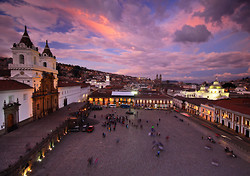
1. Arrive early - this goes for any landscape photography really, but always arrive at your location in plenty of time, not forgetting to check sunrise and sunset times on your weather app. Arriving early allows you to seek out the best compositions for your shots well in advance, as by the time darkness starts to fall, you will find that time isn't on your side! The so-called ‘blue-hour’ is the best time to capture that beautiful intense blue colour in the sky and when the city lights have started to twinkle. You may also capture a gorgeous sunset, like I did in Ecuador's capital of Quito!
2. Use long exposures – exposure is incredibly important when taking photos in low-light. You will need to use longer exposures to keep the shutter open for long enough to allow the right amount of light to enter the camera and ensure the shot isn’t under-exposed and too dark. Using an SLR camera will give greater flexibility for this and you will need to using the manual setting marked 'TV' to set the number of seconds for the exposure. Conversely, if the exposure is too long, you will end up with too much light and that speckled 'noise'. It is a balancing act and you will need to constantly experiment as react to the level of light you are shooting in. Compensate by increasing your exposure time as it gets darker.
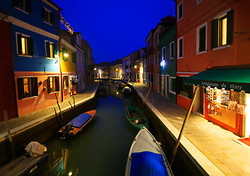
3. Use a tripod- if you are using a long exposure, it is going to be extremely hard to hold the camera still enough whilst the photo is being taken without the image turning into a blurry mess. If you don't have a tripod (which is often difficult when travelling) an alternative would be a monopod, or if you are really desperate, find something motionless to lean on. Examples I have used previously include bridges that have a flat rail (bridges in Venice are good for this) or a lamp-post.
4. Increase the ISO - consider using a higher ISO, which will enable you to keep your exposures shorter. I've already mentioned noise and, as well as a longer exposure, a higher ISO will also mean more noise.
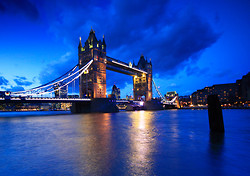
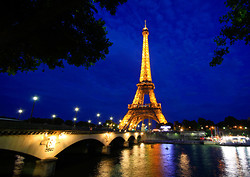
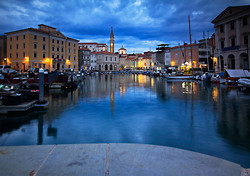
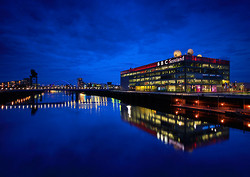
5. Find some water - if you can find some water, use it! Longer exposures will really enhance reflections of lights in lakes, rivers and harbours and give a smooth effect on the surface.
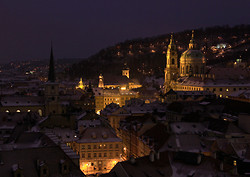
6. Wrap up warm! Winter is a great time for night shots in cities, especially if there is snow on the ground to add some extra atmosphere, like in the photo of Prague below. On a clear night, when the air is cold, it will help with creating nice crisp images. Even in summer, as night sets in it can often become a bit chilly, particularly if you are at a high altitude.
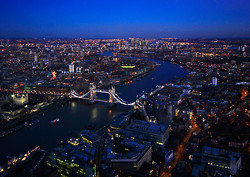
7. Height – if you can get a high vantage point, this will provide lots of interest to the viewer. Rooftops are always pretty to photograph, so make the most of the them in the dark too! The image of London below was captured from The Shard.
So...what are you waiting for! Share your photos with me on Twitter at @CharlottePics
1. Arrive early - this goes for any landscape photography really, but always arrive at your location in plenty of time, not forgetting to check sunrise and sunset times on your weather app. Arriving early allows you to seek out the best compositions for your shots well in advance, as by the time darkness starts to fall, you will find that time isn't on your side! The so-called ‘blue-hour’ is the best time to capture that beautiful intense blue colour in the sky and when the city lights have started to twinkle. You may also capture a gorgeous sunset, like I did in Ecuador's capital of Quito!
2. Use long exposures – exposure is incredibly important when taking photos in low-light. You will need to use longer exposures to keep the shutter open for long enough to allow the right amount of light to enter the camera and ensure the shot isn’t under-exposed and too dark. Using an SLR camera will give greater flexibility for this and you will need to using the manual setting marked 'TV' to set the number of seconds for the exposure. Conversely, if the exposure is too long, you will end up with too much light and that speckled 'noise'. It is a balancing act and you will need to constantly experiment as react to the level of light you are shooting in. Compensate by increasing your exposure time as it gets darker.
3. Use a tripod- if you are using a long exposure, it is going to be extremely hard to hold the camera still enough whilst the photo is being taken without the image turning into a blurry mess. If you don't have a tripod (which is often difficult when travelling) an alternative would be a monopod, or if you are really desperate, find something motionless to lean on. Examples I have used previously include bridges that have a flat rail (bridges in Venice are good for this) or a lamp-post.
4. Increase the ISO - consider using a higher ISO, which will enable you to keep your exposures shorter. I've already mentioned noise and, as well as a longer exposure, a higher ISO will also mean more noise.
5. Find some water - if you can find some water, use it! Longer exposures will really enhance reflections of lights in lakes, rivers and harbours and give a smooth effect on the surface.
6. Wrap up warm! Winter is a great time for night shots in cities, especially if there is snow on the ground to add some extra atmosphere, like in the photo of Prague below. On a clear night, when the air is cold, it will help with creating nice crisp images. Even in summer, as night sets in it can often become a bit chilly, particularly if you are at a high altitude.
7. Height – if you can get a high vantage point, this will provide lots of interest to the viewer. Rooftops are always pretty to photograph, so make the most of the them in the dark too! The image of London below was captured from The Shard.
So...what are you waiting for! Share your photos with me on Twitter at @CharlottePics